

Blog
Northland Tropical Food Forest Design Guide
Warm northern and coastal New Zealand regions can grow subtropical and tropical edibles year-round — avocado, macadamia, banana, passionfruit, feijoa and more. This guide links practical food-forest design to Troppo’s living nursery in Te Puke.
Plan layers and species with our free NZ grower tools and explore the national network at Kai Resilience.
If you’re growing in the warmer parts of New Zealand — Northland, Auckland, Coromandel, or coastal Bay of Plenty — you have access to a plant palette most of the country can only dream about. Avocado, Macadamia, Banana, Passionfruit, Feijoa, Tamarillo, Moringa, Lemongrass, Turmeric, Ginger — a real tropical and subtropical food forest is absolutely achievable.
The challenge is designing it well. A food forest isn’t just a collection of fruiting plants — it’s a layered, self-sustaining ecosystem where every plant plays a role. Get the layers wrong and you end up with a shady tangle that outcompetes itself. Get them right and you’ve built something that feeds you for decades with minimal input.
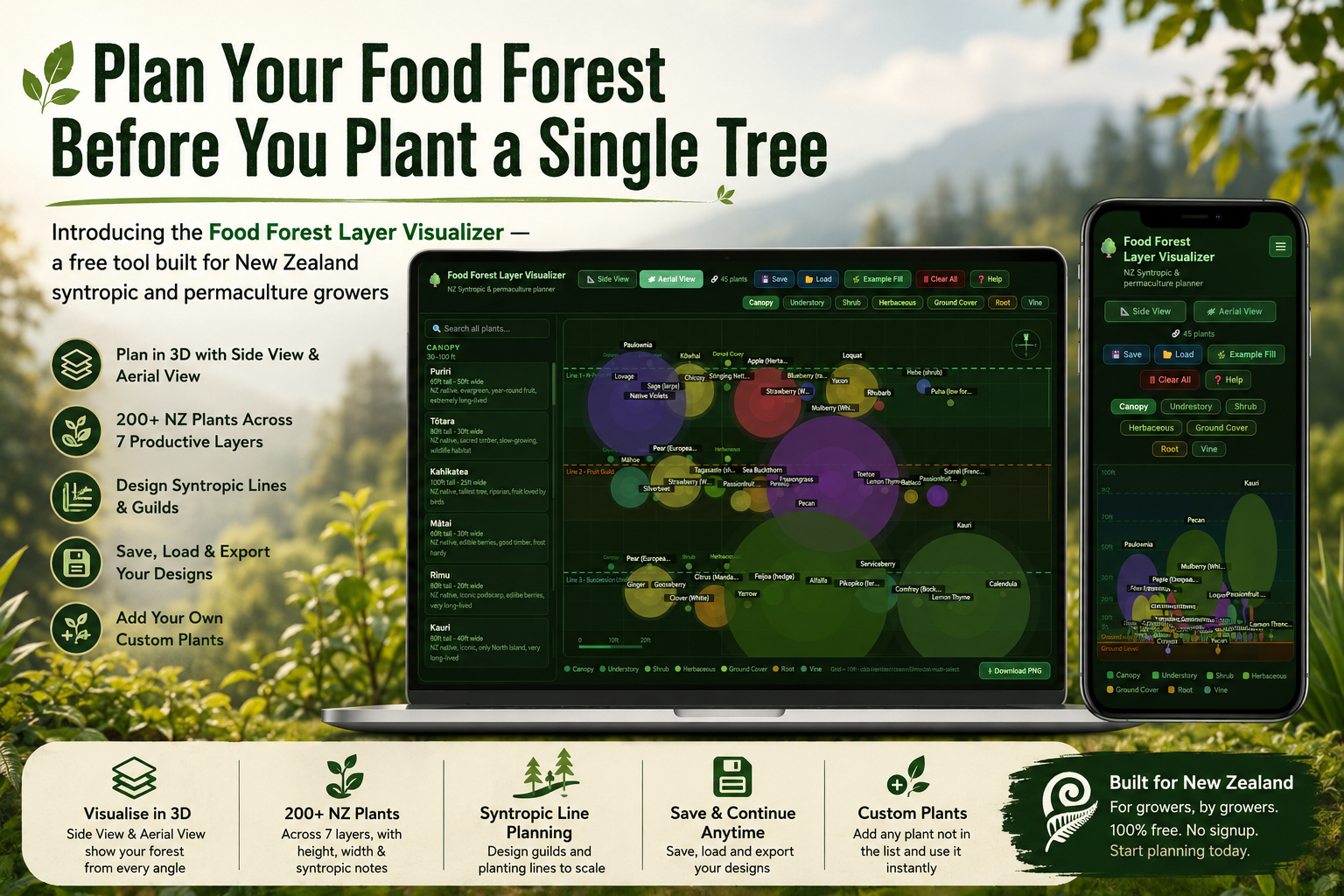
The Food Forest Layer Visualizer is a free tool that helps you design that system before a single plant goes in the ground — and it’s loaded with warm-climate NZ species.
Tropical and subtropical plants in the database:
In the canopy — Moringa, Avocado, Macadamia, Paulownia, Mulberry. In the understory — Tamarillo, Babaco, Fig, Loquat, Guava, Citrus (Meyer Lemon, Mandarin, Orange, Grapefruit). In the herbaceous layer — Lemongrass, Turmeric, Ginger, Vietnamese Mint. In the vines — Passionfruit (Purple and Banana varieties), Chayote, Malabar Spinach, Kiwifruit Gold, Hardy Kiwi. In the roots — Taro, Kūmara, Yacon, Oca, Mashua.
Design your layers visually:
The Side View cross-section shows you how a Moringa canopy relates to a Fig understory and a Passionfruit vine — all drawn at mature scale. The Aerial View shows canopy spread on a 10ft grid so you can plan spacing for a dense, productive system without overcrowding.
Use the Syntropic Lines feature in Aerial View to lay out your planting rows the way Ernst Gotsch intended — succession lines with N-fixers, chop-and-drop species, and productive layers working together.
Save your design, come back and refine it, export a map to print.
No account. No cost. Just open it and start designing.
Design your tropical food forest now
Kai Resilience & food security
- Kai Resilience — all programme posts
- Kai Resilience network — national food-resilience hub
- Free NZ grower tools — planting calendar & food-forest planner
- Food forests — design, tours and community stories
- Community & Te Puke — local BOP initiatives
- Vector Group Charitable Trust (CC45966)